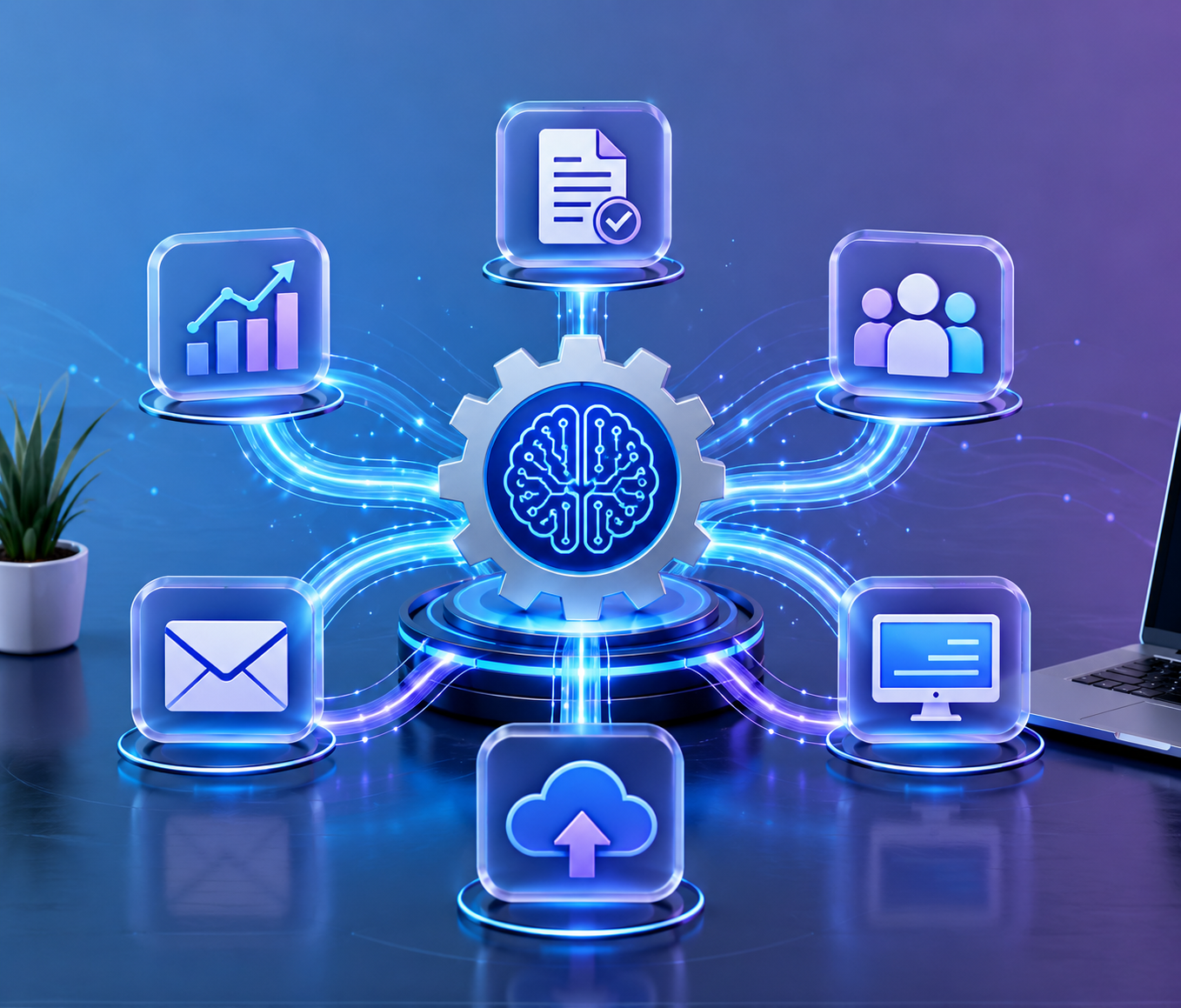
Workflows are a series of tasks that are performed to get projects done, and they’re the power behind the modern workplace. However, a significant portion of these processes are still largely manual, creating a bottleneck in the work process and reducing productivity.
AI workflow automation brings in this change by taking care of repetitive tasks intelligently. It can handle data patterns and enable you to make data driven decisions and free up human workers to work strategically and creatively, providing real business value.
In this guide, you’ll learn how to leverage AI to simplify your team’s processes and gain a deeper insight into the basics that will lead to tangible outcomes. Gain insights into the advantages of AI, its practical uses in various functions, and how to adopt AI workflow automation tools.
What is AI Workflow Automation?
AI workflow automation uses artificial intelligence to automate and handle intricate, evolving processes that surpass the capabilities of rule-based automation. AI workflow automation is flexible and does not use if-then logic, but rather utilizes machine learning algorithms to analyze data, identify patterns, and get better over time.
This enables the systems to make smart decisions based on the patterns in data, resulting in more flexible, accurate, and scalable operations. Advanced use cases, referred to as AI agentic workflows, can run with very little manual oversight, autonomously making decisions among various systems.
How does AI Workflow Automation Differ from Other Automations?
The argument that AI workflow automation surpasses traditional automations is that AI can handle unstructured data, interpret the context, and adapt to results. That implies that AI could be utilized to perform complicated jobs, for example, comprehending client feelings from help requests, arranging tickets by significance, or assigning work items to the most capable team member.
This is a Different Type of Simple Rule-Following Automation
Discuss the benefits of workflow automation in the context of AI.Explain how AI-driven workflow automation improves productivity.
The reason why organisations embrace AI workflow automation is that manual processes simply cannot solve some of its core problems at scale. The technology offers tangible benefits of productivity, accuracy, and rapidity of decision making and these advantages build up over time.
Imagine a software development team with hundreds of bug reports coming in every week. Manual triage may be time consuming and vary in priority.
AI workflow automation can process each report in real-time, categorise issues according to severity, allocate them to respective team members based on their expertise, and even foresee their resolution time frame based on past issues.
Increases Operational Efficiency for Optimal Productivity
AI workflow automation saves time-consuming, inefficient manual tasks that deplete team productivity. Employees can save hours of time from repetitive tasks like data entry, ticket routing, and scheduling and move on to more valuable tasks that require human creativity and strategic thinking.
The technology is excellent for repetitive tasks which are patterned and involve some decision making. For instance, incoming customer queries can be automatically classified, important data can be gleaned from documents, and meetings can be arranged depending on the availability and preferences of the participants.
This enhancement releases up to a lot of time that teams can commit to innovation and growth initiatives.
Minimizes errors and Improves Operational Speed to Get Faster Results
Any manual process is bound to encounter human error. With AI workflow automation, those errors are minimized because it uses a consistent logic and pattern recognition to make the right decision each time.
The technology doesn’t become fatigued, diverted or inundated by high workloads. The speed enhancement is also extremely important.
AI can handle information and perform tasks in seconds instead of minutes or hours. This speed makes an impact throughout the company. The increased speed at which they are able to perform tasks will result in faster overall operational speed, which will ultimately result in faster projects being delivered and shorter customer response times.
Improves Decision-Making with Real-Time Data Analysis
By sifting through massive amounts of data, AI can provide instant analysis that can guide organizations toward better and faster decisions. Teams will have access to real-time insights that can help them make on-the-spot decisions.
Complex or large data sets often contain trends, anomalies and opportunities that may be unnoticed by humans, but can be detected by AI.
Implement Examples of AI Workflow Automation
From every department to every industry, AI workflow automation is valuable. The technology can be customized for various applications, but the benefits are the same: easier work, better accuracy and quicker results.
The examples show how AI can be used in real-life scenarios to address specific workflow problems.
Customer service AI processes
AI chatbots, auto-routing, and sentiment analysis are all key features of modern customer support that help businesses keep up with the rising number of customer tickets while ensuring their work remains of high quality.
AI-powered chatbots deal with routine queries immediately and AI-powered routing takes complex issues to the proper specialist right away. Sentiment Analysis can be used to prioritize critical cases and uncover the customers who are likely to churn.
AI can enhance support workflows in various ways – automated ticket triage in Service Management is just one such example. The system automatically sorts incoming tickets by type and urgency and assigns them to the relevant team according to the content and skills of the tickets.
It is even possible to make an estimate of the resolution times from similar past cases. All of these contribute to significantly shorter response times and quality of service throughout customer interactions.
Marketing and Creative AI Workflows
AI is revolutionizing how marketing teams can cater to customers on a personal level, without compromising on scale. Lead scoring algorithms evaluate prospect actions to prioritise the most attractive leads, and automated content delivery optimises messages and products to the right people, at the right time.
Marketing workflows powered by AI can optimize ad budgets to maximize conversions, even when performance fluctuates, segment customers by behavior, and send personalized email sequences based on customer behavior.
These features allow marketing teams to run their processes more effectively and achieve superior results.
Human Resources AI Workflows
AI automation can make HR tasks easier, especially when it comes to recruitment and employee onboarding. AI can sift through resumes to match them with job requirements, arrange interview times according to availability, and perform preliminary evaluation with the help of AI chatbots.
AI simplifies document processing, access provisioning, and training schedule coordination, streamlining the employee onboarding process. This automation will provide a uniform experience for new hires, while saving HR teams time and effort.
IT and Operations AI Workflows
AI workflow automation enables IT teams to proactively monitor systems, respond to incidents automatically, and implement deployment more efficiently.
AI can identify anomalies in system performance, generate tickets for possible issues without any manual work and even perform remediation procedures for common system issues using remediation scripts without any impact on human resources.
AI’s benefits to deployment workflows include its capacity to analyse code changes, anticipate potential conflicts and optimise release timings based on system load and team availability. This intelligence helps prevent downtime while accelerating software delivery cycles.
AI Applications for Finance and Accounting Processes
AI-powered invoice processing, expense categorization and fraud detection improve financial workflows. With AI, invoices can be scanned, matched to purchase order, and approved automatically via the company’s rules and procedures.
AI can also aid in budget forecasting by analysing spending trends, market forecasts, and historical data to forecast financial needs. Automated insights create better-informed financial decisions and save finance teams time on manual analysis.
In this section, you will Learn How to use AI in your Workflows Step-by-Step
The key to implementing AI workflow automation software is to strike a balance between ambition and practicality. It goes without saying that small companies with the right tools and those that measure their efforts accurately, are more likely to have positive results than those that try to change everything right at the start.
Step 1. Find Repetitive and Rule-Based Tasks that can be Automated
Identify time-consuming but repeatable tasks in the workflow. This often includes:
- Data entry
- Ticket routing
- Status updates
- Document processing
The processes that involve lots of data and a lot of time are all excellent candidates to begin with because they have obvious automation options that involve minimal risks. Start with predictable flows and gradually work up to more complex scenarios to develop confidence in the organization.
Step 2. Prioritize AI features
For effective integration of AI in workflows, focus on AI capabilities that directly minimize manual tasks and enhance planning. For instance, with AI Work Create in Jira, repetitive entries on Confluence pages, chat threads, and emails are reduced, as AI automatically generates tasks.
AI Work Breakdown breaks down large projects into actionable tasks in List and Timeline views, enabling you to plan deliverables, milestones, and capacity. Rovo Chat allows writing, reviewing and creation of work items in a conversational manner.
It accelerates workflows, makes them smarter and more aligned by helping to configure workflow transitions using natural language.
Step 3. Ensure Early Team Adoption for Successful AI Implementation
No matter how sophisticated your AI solution is, it won’t produce a positive outcome without your team’s cooperation. The first step to successful adoption is to show team members how AI functions, what issues it can resolve, and how it can improve their workflow.
Involve team members and leaders right off the bat to ensure AI solutions meet business needs. Early involvement identifies workflow inefficiencies, minimises resistance to change and establishes change champions who can facilitate change adoption throughout the organisation.
It’s important too that they have an open line of communication. Encourage team members to ask questions, hear what they have to say, and discuss any concerns they might have about the success of your team. Acknowledge achievements and demonstrate successes to boost confidence.
The better your team understands and trusts AI, the more your workflows and productivity will be enhanced.
Establish clear KPIs right from the get-go and base them on measurable results such as time saved, task completion rates, error reduction, or user satisfaction scores. Monitoring on a regular basis identifies opportunities for improvement, and can be used to determine if models need retraining or adjustment due to shifting business needs.
Conduct periodic evaluations and feedback mechanisms to enable your AI to learn from its errors and improve its precision with time.
The Difficulty in the Implementation of AI in Workflow Automation
AI has many advantages, but there are also some valid concerns to consider, such as data security, algorithmic bias and user adoption. Successful implementations recognize these issues and incorporate protection measures to offset the risks of automation while still capturing the benefits.
When dealing with sensitive information, data privacy and security must be given due consideration for AI processes. Use strong data security measures such as access controls, encryption, and audit trails to safeguard sensitive information while allowing AI operations.
Try to keep human involvement in decisions that have a significant impact on customers or employees.
Streamline Workflows with AI-powered Automation
By leveraging AI, workflows can help teams revolutionize the way they manage projects and track work throughout the entire development lifecycle. Intelligent automation capabilities include capabilities that guide teams to automatically categorise issues by content and context.
This enables you to simplify backlog grooming by grouping similar user stories together, and create valuable reports that reveal patterns of team performance. Teams can use pre-built workflow templates to start their automation quickly, and then customize rules for the specific needs of their organization.
The kicker is that it’s powered by Rovo, Atlassian’s AI platform. Rovo is a single place that lets you discover relevant content in all your Atlassian products with AI assistance.
This smart chat interface can respond to questions regarding projects and processes, and independent Rovo agents that can carry out complicated procedures on your behalf. It’s the perfect way for teams to get enterprise-grade AI capabilities without additional tools or complexity.