Internet of Things (IoT) is changing the way people live, work, and relate to technology. IoT is making daily life more convenient, efficient and automated with connected devices, such as smart home appliances, connected vehicles and wearable devices. This technology is used to link physical devices to the internet, allowing them to gather, share and analyse data with little human involvement.
IoT has become a key component of today’s homes, offices, healthcare networks, transportation, and industrial spaces, as digital transformation continues to expand in 2026. Explore the concept of IoT and its applications to gain insights into its expanding importance in today’s technologically driven world.
What Is the Internet of Things (IoT)?
The Internet of Things is the internet of physical objects that are embedded with sensors, software and the internet. These objects can interface with other devices and systems to exchange information and carry out certain functions.
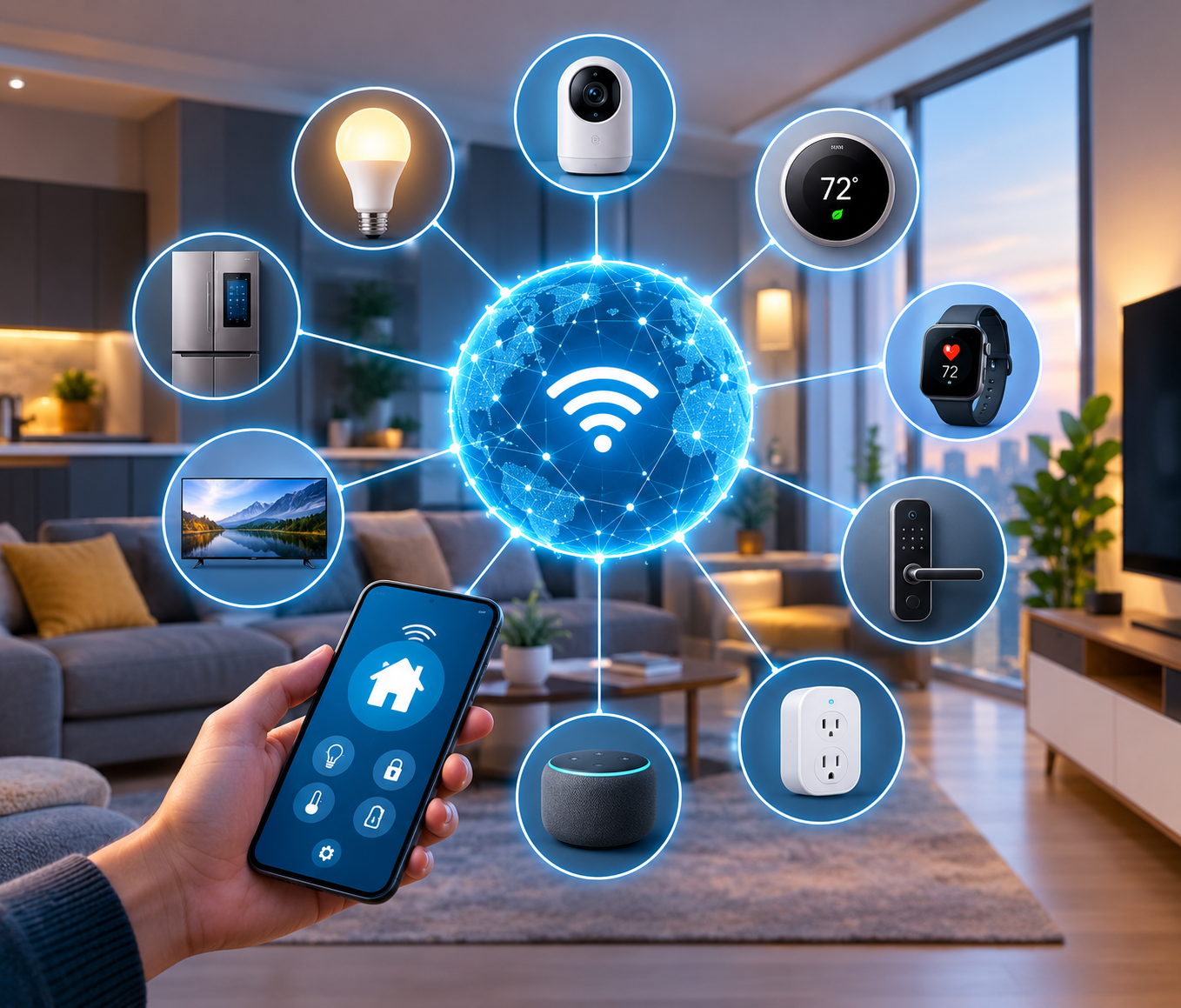
These can be anything from smart thermostats, fitness trackers, connected security cameras, smart TVs, and industrial sensors. These devices sense the environment, and then carry out some sort of action that is helpful or automated.
For instance, a smart thermostat can track indoor temperatures and automatically turn the heating or cooling on/off. Likewise, a fitness tracker will keep track of steps taken, heart rate and activity levels on a daily basis, so that you can keep track of your fitness status.
How Does IoT Technology Work?
To achieve this, the IoT technology brings together a number of elements.
Sensors and Connected Devices
Information is gathered on temperature, movement, humidity, pressure, and location through sensors. This information is used by connected devices to learn about their surroundings and adjust to variable conditions.
2. Internet Connectivity
Devices share collected data via communication technologies like Wi-Fi, Bluetooth, cell phone networks, and other wireless technologies. The right connection will depend on the purpose, range and power requirements of the device.
3. Data Processing
Data is collected and processed either directly on a device, via an edge computing system or on a cloud platform. This process goes through the steps of detecting patterns, identifying unusual activity, and deciding on a next action.
4. Automation and User Control
When the information is processed, an IoT system can take automatic action, or alert users via a mobile application. For example, if a connected security system detects unusual movement, it can alert you.
How is IoT changing everyday life?
The Internet of Things is affecting our lives by making everyday things more interconnected and easier to deal with.
Smart Homes and Home Automation
Smart home technology enables users to manage security systems, thermostats, appliances, and lighting, all via a connected device. Users can make settings remotely, set schedules and automate repetitive tasks.
For instance, intelligent lights may turn off automatically when nobody is in the room, while clever doorbells enable homeowners to see who’s at the door on their smartphone.
These solutions can enhance convenience, aid with energy management, and offer increased visibility into home security.
Healthcare and Fitness Monitoring
Healthcare providers and individuals are increasingly taking advantage of connected devices and wearables to keep track of critical healthcare metrics with the help of IoT. Fitness trackers can store data, and some medical devices can send data to a healthcare provider.
The ability to monitor remotely can help facilitate better informed care decisions and facilitate long term treatment planning. Medical devices, however, must be used in the appropriate way and important health choices should be made with the help of qualified health professionals.
Smart Transportation
Vehicle monitoring, traffic management and navigation and fleet tracking are all being enhanced by connected technology. IoT sensors can give info on the state of the roads, how the vehicles are functioning, and the flow of traffic.
Connected systems can be used to track vehicle locations, plan routes, and determine maintenance requirements for businesses with delivery fleets. These can be applications that help to minimize the unnecessary delays and make the operational efficient.
Smart Shopping and Retail
IOT technology helps retail companies keep an eye on their stock, track equipment and optimize store processes. Staff can be alerted to the low stock of the products using connected shelves and sensors, allowing them to plan and replenish products more efficiently.
Smart inventory systems also offer improved visibility of product movement, which aids businesses to minimize stock outages and enhance customer experience.
What are the key advantages of IoT technologies?
There are a number of benefits that IoT brings in the personal, commercial and industrial world.
- More convenience: Smart devices make life easier to handle from a distance.
- More efficient operations: Automation eliminates repetitive tasks and optimizes workflow.
- Improved decision making: Useful information for planning and problem solving because data is available in real-time.
- Energy management: Smart systems can track the use of energy resources and curtail any unnecessary consumption.
- Predictive maintenance: Sensors can detect warning signs prior to some equipment failures.
- Improved monitoring: Connected devices deliver real-time data on assets, environments and processes.
The value of these benefits is dependent on the integration, maintenance and configuration of the devices to provide the specific benefits.
How IoT is Shaping Today’s Businesses
More companies, from all across the board, are implementing IoT solutions to boost productivity and maintain the resources better.
In the manufacturing sector, connected sensors can track the performance of the machines and detect abnormal operating conditions. Soil sensors can be used in agriculture to track the moisture content and make informed irrigation choices. Tracking can be used to keep a check on the shipments and increase supply chain visibility for logistics companies.
Furthermore, IoT helps to enable data-driven business decisions. When connected equipment and operations provide information to the organizations, they can determine efficiency, enhance service quality and be faster to meet changing requirements.
The use of AI and analytics can enhance the capabilities of IoT systems, offering more comprehensive insights and enabling greater levels of automation.
What Security Issues are associated with IoT?
However, the potential benefits of IoT come with some key security and privacy issues. Any device used on the network can provide another spot of vulnerability if it is not secured.
Insufficient passwords, software that is not up-to-date, unsecure network connections, and improper device configurations can make users and organizations vulnerable to cyber threats.
There are several good practices that can help businesses and individuals minimize these risks:
- Use strong and unique passwords; change default passwords.
- Regularly install software and firmware updates.
- Provide multi-factor authentication, if possible.
- Consider separating IoT devices from the primary network as appropriate.
- Check the settings for data access to these devices and restrict the collection of unnecessary data.
- Buy equipment that offers dependable security updates.
Organizations also should have a policy to collect, store, access, and remove data. Building trust in connected technology hinges on strong security measures.
What Is the Future of the Internet of Things?
The future of IoT will see increasing AI, edge, advanced connectivity, and automated decision making integration. The developments can aid connected systems to respond quicker to changing conditions by analyzing information faster.
Smart buildings could also be easier to control in terms of energy management, and connected factories could be more efficient in monitoring equipment or planning production. More accurate resource management for agriculture, and the use of connected data for better traffic coordination for transportation systems.
But affordability, interoperability, privacy protection and reliable infrastructure will be key to success. Before undertaking large-scale IoT solutions, organisations need to assess the pros and cons.
Conclusion
The Internet of Things (IoT) is transforming people’s everyday lives by linking physical things to digital systems. IoT is transforming information into something more accessible and routine processes into something more efficient, from smart homes, to wearables, to healthcare monitoring, to transportation, and even to industrial automation.
While security, privacy and compatibility issues will still be a challenge, their responsible use can bring benefits to users and businesses. With the continuous development of IoT, it will be an indispensable part of the construction of smart homes, efficient industries, and intelligent communities.