Technology is changing at a quick pace in today’s fast-paced digital world. This is especially true in the world of digital marketing, with the rise of artificial intelligence (AI) and its revolutionizing impact on the industry.
The global AI market is expected to be worth more than $1.5 trillion by 2030. A recent survey by Fortune/Deloitte revealed that 79% of CEOs feel generative AI will boost efficiency, while half of CEOs surveyed (52%) say it will provide growth opportunities.
To gain and maintain a competitive edge, it’s vital for marketers to incorporate the latest tools and core strategies to improve their companies’ potential for success. Read on to learn more about some of the ways in which AI is changing the face of digital marketing.
The Importance of AI in Digital Marketing: Brief Overview
For decades, AI has been driving technologies in digital marketing through the use of machine learning. The advent of the Internet and e-commerce opened additional avenues for collecting and analyzing data. They also allowed for a novel type of advertising and targeting. Digital marketers and web owners were able to leverage this data and interact with customers online through the use of early AI tools like content recommendation algorithms and email marketing software.
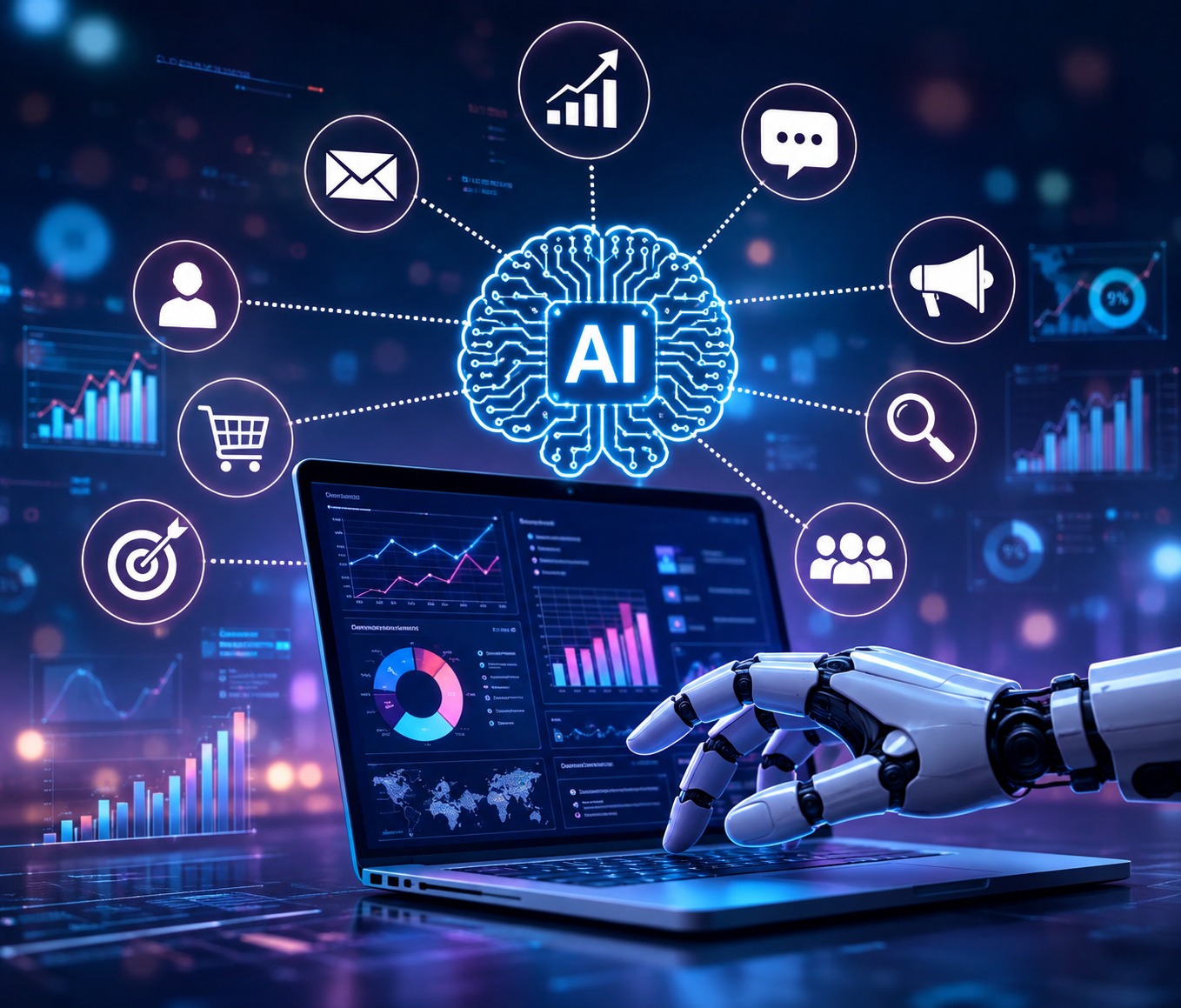
Emerging technologies like cloud computing, natural language processing (NLP), and deep learning set the stage for an era of AI implementation. Now, marketers leverage AI to generate content, fine-tune campaigns, boost conversion rates, predict outcomes, enrich the customer journey, and beyond.
AI is radically changing the way brands and consumers interact and communicate with each other. Over the years, AI has become recognized as the most influential technology for business. It’s like it’s just the start of something.
What’s all the Talk About GPTs, anyway?
The Generative Pre-Trained Transformer (GPT) is the acronym that was used. It is important because it does a few important things including:
Generative Capability: GPT models can generate human-like text based on the prompts they receive. The capacity to produce content, whether it’s an article, social media post, or a response to customer support inquiries, is revolutionizing the way content is created, which is valuable in different sectors such as marketing, content generation, and customer support.
Pre-training Advantage: The “Pre-trained” part is that these models are pre-trained on a large collection of text data, and then they are fine-tuned. This pre-training enables GPT models to understand and generate text with a deep understanding of language, context, and even some nuances of human communication.
The model architecture is known as “Transformer,” and it is very efficient in processing sequential data (such as text) and maintaining a context over long spans. With this architecture, GPT can generate coherent, contextually relevant text, making it a powerful tool for generating content, translating languages, summarizing documents, and more.
The Ultimate Guide to AI in Digital Marketing
GPT’s value to marketing is its ability to streamline and improve content creation processes. It can assist marketers in creating engaging written content and personalizing customer communications at a large volume, as well as provide insights from large volumes of data. This results in the adoption of better marketing strategies, engagement with the customers and ultimately, a better presence of the brand. Below are some of the examples of AI in Digital Marketing and how it enhances processes, automates repetitive activities, and helps customize content to match customer needs.
Content and Communication
Content creation
In terms of content creation, AI can enhance the quality and effectiveness of content, as this content can be generated and tailored using the vast amount of data. In other words, the data is continuously distilled to create higher and higher quality content.
AI technology is also able to save marketers time and energy. Using external data and user preferences, AI-powered content creation tools can generate more relevant content automatically. AI-powered tools can recommend content ideas, refine headlines, and adjust content as users interact with it.
The ease with which content is easily created and customized reflects the fact that artificial intelligence has become more pervasive and ubiquitous and the barrier to access has gotten lower.
Customer service
AI communication has been found to aid customer service communication as well. AI-driven customer service allows for proactive interactions, fostering customer engagement, McKinsey said.
Generative AI helps to generate customer service content and can also go through user feedback to understand important details and create replies that have a similar tone to human interaction, which will boost customer fulfillment and accelerate response times.
AI-powered chatbots have become much more interactive and engaging, and are now playing a crucial role in a digital marketing campaign. “They offer personalized customer support, collect data for lead generation and analysis, and improve engagement and customer satisfaction.”
Analytics and Optimization
Leveraging AI for Data Analysis
AI’s role in data analysis can also forecast future trends at a remarkable pace and efficiency, thereby aiding in the formulation of digital strategy. According to the Alan Turing Institute, AI for data analysis allows for processing at speeds and quantities that lead to more accurate business insights. Access to this information and the ability to turn it into actionable knowledge are just some of the advantages of harnessing the power of AI.
Digital marketers can use AI-powered text analytics tools to also interpret and evaluate unstructured data, such as reviews and social media comments, for valuable insights into customer preferences. Overall, AI has emerged as a valuable tool for analysts to streamline numerous time-consuming and repetitive tasks, thereby maximizing their time for strategic initiatives.
Consumer targeting
With the help of AI, companies can segment and target audiences intelligently within large populations, ensuring that every target audience is precisely targeted with the appropriate products and services.AI has enabled segmentation and targeting at a more granular level within larger groups, allowing companies to target specific individuals with the right products and services. With the growing amount of data, AI can help marketers stay up to date with consumer demand.
Research by McKinsey shows that “Advanced algorithms can use patterns in customer and market data to segment and target relevant audiences, with these capabilities, businesses can efficiently analyze and identify high-quality leads and create highly optimized lead-engagement strategies directly for them.
AI has given marketers an opportunity to fill in the gaps of traditional targeting. It can detect missing information according to demographics, behavior and purchasing habits. By utilizing these insights, generative AI can then be used to generate content. By leveraging AI for segmentation, businesses can enhance their conversion rates, customer retention, and ROI.
Personalization and Customer Experience
As we can see, AI is assisting marketers to “move past the boundaries of human engagement and individualize marketing to their customers.”
In addition to generative AI content creation that can be fine-tuned for each consumer, AI is adept at handling visual content such as images and videos. It can recognize people, places, objects, and other details, which helps facilitate automated tagging and enhanced search functionality. The technology is useful in streamlining the organization of these assets and further facilitates customization.
As AI technology progresses, it’s also being employed to conduct personalized experiments for companies’ customers based on the product suggestions, pricing strategies and optimized incentives. Today, customers demand that Brands, particularly the ones we use the most, know our preferences on a personal level.
Published by SPS Academic Director and Professor of the Practice, Ged King
Advance Your Expertise with a Graduate Degree in Digital Marketing
There’s much to explore when it comes to artificial intelligence and digital marketing. Lead the future of digital marketing, while developing leadership abilities at Wake Forest University.
The online Master of Digital Marketing and AI program at the Wake Forest University School of Professional Studies (SPS) was designed and is taught by industry experts and thought leaders. Fully online, it offers you the flexibility to take classes on your schedule and at your own pace with a like-minded community of marketing professionals and faculty.