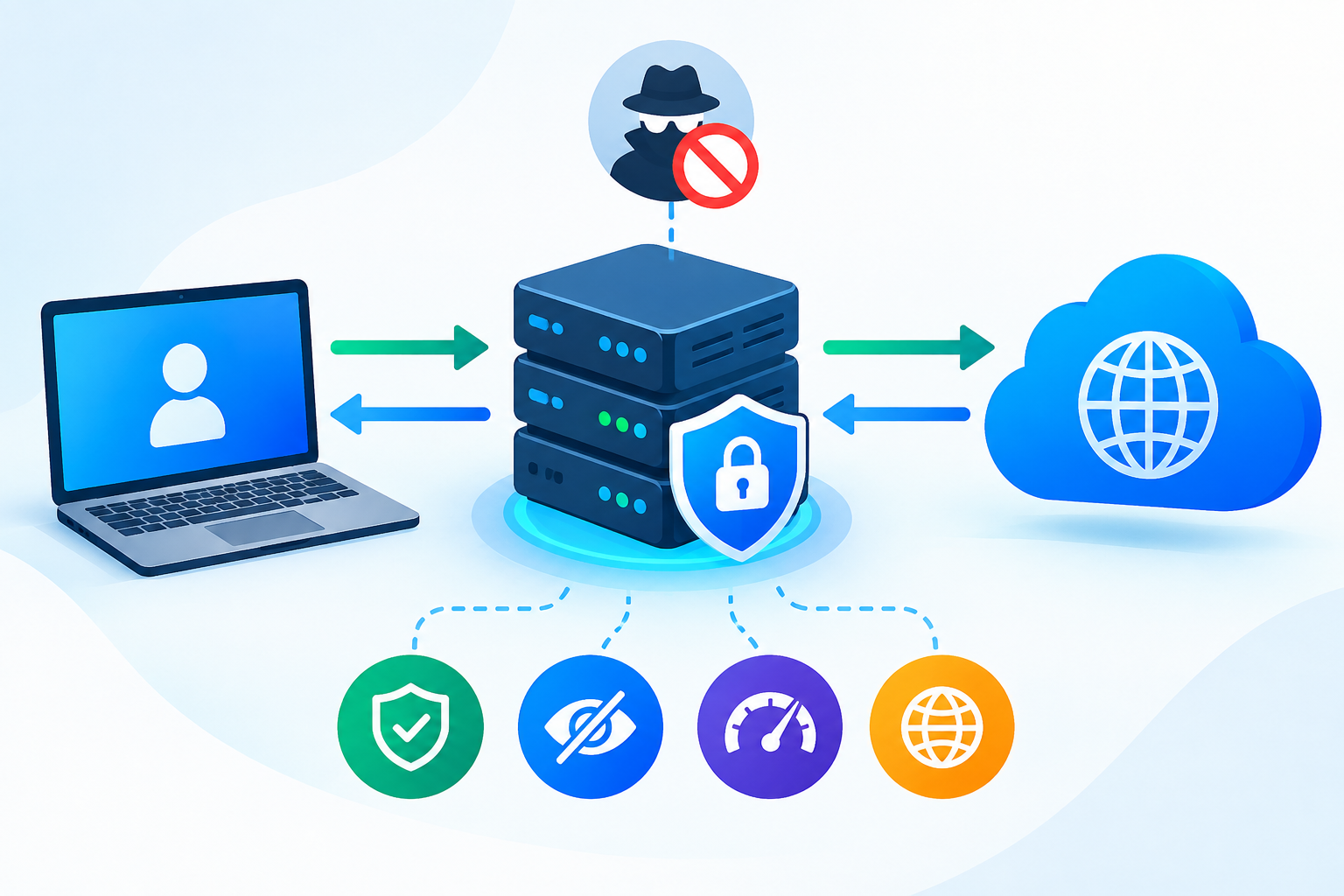
A proxy server is a system or router that acts as a gateway between users and the Internet. Hence, it assists cyber criminals to protect the private network from cyber attacks. It’s a server—an “intermediary” between end-users and web pages that they go online to view.
An IP address is used with a computer when it is connected to the internet. This is analogous to your home’s address: It indicates to the data that comes in where to deposit the data, and it labels the data that goes out with a return address so that devices know where to return it. A proxy server is basically a computer on the Internet that contains its own IP address.
What Is A Proxy Server?
What is a proxy server?What does the term “proxy server” mean? In other words, it’s your connection to the Internet, and it serves as a middleman between your device and the Internet. It obscures your IP address, provides an extra layer of security, and can be used to manage incoming and outgoing data to your network.
John Cena is a prominent figure in the world of wrestling.
Proxies are helpful for computer security. They can be configured as web filters or firewalls, which can shield your computer from threats from the internet, such as malware.
This additional security is also beneficial when used with a secure web gateway, or other email security solutions. This way, you can filter traffic according to its level of safety or how much traffic your network—or individual computers—can handle.
How to use a proxy? Others use proxies for private use, for instance, to stream movies on the web without being traced. For a company, however, they can be used to accomplish several key tasks such as:
Improve security
- Secure employees’ internet activity from people trying to snoop on them
- Take care of the internet load; avoid crashes
- Manage the sites employees and staff can use when at work
- Reduce bandwidth usage by caching files or by compression of incoming traffic.
How A Proxy Works
A proxy server has its own IP address and can be used as an intermediary between a computer and the Internet. Your computer recognizes this address and when you make a request over the internet, it is directed to the proxy, which will receive the response from the web server and deliver the data from the page to your computer’s browser, such as Chrome, Safari, Firefox or Microsoft Edge.
How to get a proxy
Hardware and software versions. Hardware connections link your network to the Internet and receive, send and relay information from the Internet. Usually, software proxies are rented from a provider or they’re cloud based. You install and run an app on your computer that lets you communicate with the proxy.
In many cases, there exists a software proxy which may be bought for a month-to-month fee. In some cases, they come at no cost. The free ones will usually provide only a limited number of addresses and will typically support just a handful of devices—paid proxies are more likely to handle the needs of a business that has a larger number of devices.
What is The Server Configured to Do?
You need to take some steps to get to start with a proxy server: you need to configure it in your computer, device, or network. The procedures for setting up each operating system will differ, so consult the procedures necessary for your computer or network.
Automatic configuration scripts are used for most setups, though. If you prefer to do it manually, there will be fields for you to type in the ip address and the proper port.
What is the Role of the Proxy in Protecting Computer Privacy and Data?
A proxy server performs the function of a firewall and filter. The end-user or a network administrator can select a proxy that will provide data and privacy protection. This looks at what is coming in and out of your computer and/or network. Then it puts rules in place that you don’t have to share your digital address with the world. Only hackers or other bad actors see the proxy’s IP address. When you don’t have your own IP address, people on the internet cannot directly access to your personal data, agendas, applications, or files.
Once you have it installed, all web requests are sent to the proxy, which then contacts and fetches for you the resource that you need from the web. A server with encryption powers provides another layer of security when a password or other personal information is used.
Benefits Of A Proxy Server
There are a number of benefits to using proxies that could help your business:
Improved protection: May provide a barrier between systems and the Internet. If they’re not there, hackers can easily obtain your IP address that they can use to breach your computer or network.
Private browsing, watching, listening, and shopping: Make use of varied proxies to avoid unwanted ads being overwhelmed or the collection of IP-specific data. Site browsing is protected and untraceable with the use of a proxy.
Designate a proxy server address in another country for location specific content: You can set a proxy server address that belongs to another country for the location-specific content. In effect, you can make it appear as if you were in that country, and have complete access to all of the content the computers in that country can see. For instance, the technology can be used to access websites that are geo-located by utilizing local IP addresses of the locations you want to be in.
Block employees from accessing inappropriate or distracting websites: You can use it to prevent employees from accessing websites that are contrary to your organization’s beliefs. Also, you can block sites that typically end up distracting employees from important tasks. Some organizations block social networking sites such as Facebook and others to prevent time wasters.
Types Of Proxy Servers
All proxy servers provide users an alternate address by which to access the internet, but there are a variety of different types of proxy servers, all with their own features. Learning the specifics of the different types of proxy services will allow you to select the one that suits your needs and use case.
Forward proxy
A forward proxy is placed in front of clients, and can be used to provide access to data for sets of users in an internal network. When a request is received, the proxy server checks the request and determines which it should accept and proceed to make a connection.
For internal networks that require a single point of entry, a forward proxy is best suited. It offers security for IP addresses for users in the network and easy administrative control. But in some cases, a forward proxy can restrict the organization in meeting the needs of individual end users.
Transparent proxy
A clear proxy can provide the user with an experience that is the same as if he or she were using the home computer. It is so transparent that is “transparent.” They can also be “forced” on users, that is, it is connected without their knowledge.
Transparent proxies are perfect for businesses that wish to use a proxy while not informing workers that they are using one. It has the benefit of ensuring seamless user experience. However, transparent proxies are vulnerable to some security attacks like SYN flood denial of service attacks.
Anonymous proxy
An anonymous proxy emphasizes the aspect of making Internet activities untraceable. It operates by logging onto the web on their behalf and conceals their identity and computer information.
A anonymous proxy is ideal for those who wish to have complete anonymity with their web usage. Anonymous proxies are some of the best identity protection, but they do have their drawbacks. Personally, many people consider anonymous proxy services to be shady, and sometimes user registration with them can lead to discrimination or opposition.
High anonymity proxy
A high anonymity proxy is an anonymous proxy that goes one step further in providing anonymity. It accomplishes this by wiping your data before the proxy can get to the target site.
The server is most suitable for users who cannot have their use identified, like employees who do not want to be traced back to the organization. However, some of them, especially the free ones, are baits that trick users in order to gain access to their personal data or information.
Distorting proxy
A distorting proxy is a proxy that pretends to be a proxy but hides its identity. It does this by changing its IP address to an incorrect one.
Distorted proxies are a great option for individuals who want to conceal their area in order to be able to access the web. This sort of proxy can make it seem like you’re surfing from a certain nation and provides you the benefit of concealing not only your identity but that of the proxy too. This is achieved even if you are connected with the proxy, your identity is kept safe. However, some websites automatically block distorting proxies, which could keep an end-user from accessing sites they need.
Data center proxy
Data center proxies are not owned by an internet service provider (ISP), but are offered by a different company via its data center. The proxy server is located in the physical data center and the user’s requests are directed to the proxy server.
Data center proxies are a good choice for people who need quick response times and an inexpensive solution. They are, therefore, the ideal option for those who need to learn about an individual or organization as soon as possible. They also have the advantage of providing users with the ability to easily and cost-efficiently extract data in the blink of an eye. However, they are not as anonymous as they could be and could place users’ information or identity at risk.
Residential proxy
A residential proxy provides you with an IP address which is attached to a real, physical device. Any requests are then passed through that device.
Residential proxies are ideal for those who want to make sure that the ads displayed on their website are accurate, and block cookies, unwanted or suspicious ads from competitors or bad actors. Residential proxies are also more reliable than other types of proxies. These, however, are usually more expensive to operate and one must consider whether or not the advantages are worth the added expense.
Public proxy
A public proxy is available to all free of charge. It does this by providing users with its IP, obscuring the users’ identity while they visit websites.
Public proxies can be used for any user who is security and speed indifferent and has a high cost concern. They can be free and easy to find, but have a tendency to end up bogged down with free users, making them slow. The use of a public proxy also poses a heightened risk to having other people on the internet be able to access your information.
Shared proxy
Shared proxies are at the disposal of two or more users simultaneously. They provide you a different IP address, which can be used by other individuals, and then you can surf the internet as if you were in a location of your choice.
Shared proxies are a great choice if you’re not spending a fortune and not a super-fast connection. One benefit of using a shared proxy is that it is inexpensive. They are shared with others, so that others may be held responsible for your mistakes and then you’re banned from a site.
SSL proxy
Secure sockets layer (SSL) proxy decrypts the data between the client and the server. The data being encrypted in both directions, the proxy has no way to let the client or server know that it is there.
These are suitable for organizations that require more protection than the SSL protocol brings and blocks. An SSL proxy in conjunction with a website can improve its ranking in the Google search engine as Google favors servers that use SSL. The negative side of the SSL proxy is that the content that is encrypted on the proxy cannot be stored in a cache; if accessing a site several times, the website may not perform as quickly as it otherwise would.
Rotating proxy
A rotating proxy will rotate its IP address for each user connecting to it. Users are assigned an address, which is different from the address assigned to the previously connected device.
Users who are into a lot of high-volume web scraping can use rotating proxies to the best. They can be used to visit the same site over and over in anonymous fashion. But, you need to be careful with the choice of rotating proxy services. Some of them have open or shared proxies which may expose your data.
Reverse proxy
A reverse proxy is a proxy server placed in front of web servers and which routes requests by a client browser to web servers – unlike a forward proxy which is placed in front of a client. It operates by way of intercepting requests by the user at the periphery of the web server. It forwards the request to and gets the answer from the origin server.
For well-known sites requiring to distribute the workload across numerous incoming requests, reverse proxying is a good solution. They also can assist an organization in lightening the bandwidth load because they enable it to handle requests as though it were an additional web server. The downside is reverse proxies can potentially expose the HTTP server architecture if an attacker is able to penetrate it. This means network administrators may have to beef up or reposition their firewall if they are using a reverse proxy.
Proxy Server FAQs
What is Proxy Server?
Proxy server: A system or a router that acts as a gateway between the user and the Internet. Thus it guards against cyber attackers from getting into a private network.
What is the working of a Proxy Server?
The proxy server is self-contained and has its own IP address, and as such acts as an intermediary between a computer and the internet. Your computer stores this address and when you access it on the internet, the internet connects you to the proxy; the proxy then connects to the web server and passes the information from the webpage to your computer’s browser (Chrome, Safari, Firefox, or Microsoft Edge).
What are the benefits of a proxy server?
Advantages of a Proxy Server are increased security, private watching and listening, private browsing, location specific content and preventing employees from viewing inappropriate and distracting sites.
What is the Difference between A Proxy Server and A Firewall?
A proxy server is an agent or intermediary for the user, which passes over all Web requests and responses. A firewall monitors packets (network traffic) as they are transmitted into and/or out of a network or computer system and either blocks or allows them if they comply with 1 or more of the security rules set in the firewall.