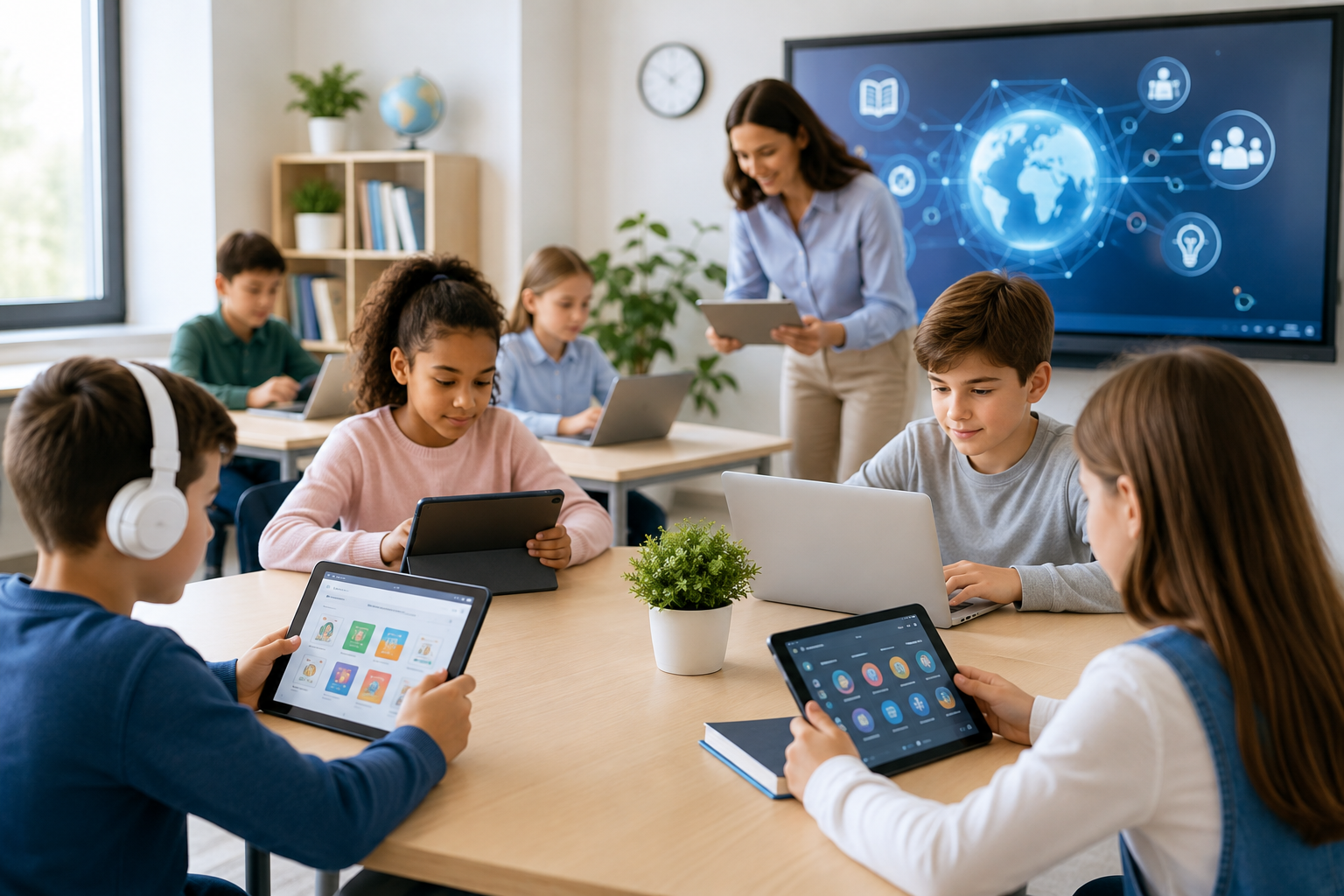
Technology is playing an important role in today’s education. Technology gadgets are transforming the way students learn, and the way teachers teach, from tablets and laptops, to interactive whiteboards, smart projectors, educational apps, and digital learning devices. When used appropriately, these gadgets can enhance the interactive, accessible, flexible and engaging nature of education.
Using technology gadgets in learning is not just about the substitution of classroom and books. Rather, gadgets could supplement the traditional classroom curriculum to offer pupils extra information, hands-on learning experiences, and quicker access to information. They can also aid teachers in developing more individualized and interactive learning experiences.
What are Technology Gadgets in Education?
Technology gadgets used in education are electronic items that are used to back learning and teaching. Laptops, tablets, smartphones, smartboards, projectors, e-readers, educational robots, digital cameras, virtual reality devices are some of the common examples.
These tools can give access to educational sites, eBooks, learning apps, videos, presentations, online education, quizzes, and interactive learning activities. Technology can be used for a wide range of activities in the classroom from simple to complex, depending on students’ age and requirement.
How Technology Gadgets Make Learning More Interactive?
The greatest benefit of educational technological gadgets is that they can enhance the interactivity of lessons. It can be challenging for students to pay attention for extended periods during traditional lectures. Digital tools can add videos, animations, simulations, games, quizzes and interactive presentations.
A science teacher, for instance, may explain the working of the human digestive system using an animation. Students can visually see each step of the process, rather than just reading about it. In a similar fashion, Geography students can learn about digital maps and virtual places.
Interactive learning helps students to not only listen to and take notes but also be involved in.
How Do Gadgets Give Easy and Accessible Information?
Technology gadgets allow students to have instant access to a wealth of educational information. The Internet, accessed via a laptop or tablet, can offer access to digital libraries, research papers, online learning courses, educational videos, dictionaries, and other educational resources.
This may be helpful when students wish to delve deeper into a subject they have read about but not covered in their reading materials. Teachers may also provide extra reading materials and resources via the internet so that students can read them as needed.
But pupils need to learn about how to recognise reliable information, as not all information found online is accurate.
Is the use of Technology Gadgets Effective in Supporting Personal Learning?
All students have unique learning styles. It is important to note that some students may grasp concepts quickly, while others may require further explanations and practice. Personalized learning can be achieved through the use of technology gadgets as students can learn at their own speed.
Different levels of exercises, quizzes and practice activities can be provided with educational applications. Students may go back to lessons if needed for additional support; progress through lessons when confident.
This flexibility can ease learning and enable students to concentrate on areas in which they need to improve.
How can Educational Gadgets Enhance Student Engagement?
One of the challenges that teachers face is to keep students interested in a lesson. Technology can be used to create more engaging educational activities, incorporating visual, audio, and interactive components to the learning experience.
Student-friendly activities like educational games, digital quizzes, virtual experiments, and interactive assignments can help to motivate students. Gamification can also include points, challenges, badges and progress tracking to make specific learning activities more motivating.
Technology can promote curiosity and active engagement when it has purposeful learning objectives.
How Do Gadgets Help Teachers?
Technology gadgets can be helpful for teachers and students. Teachers use the laptop, tablet, projector, smartboard, and educational software to create and instruct in lessons.
The digital tools can be used to help teachers prepare presentations, administer online assessments, set up assignments, distribute learning resources and track student progress. Some of the educational websites can also supply performance data to the teachers that they can use to determine what subjects students are not succeeding in.
This allows teachers to leverage technology alongside their expertise and manage classrooms and plan lessons more effectively.
How do Technology Gadgets Support Collaboration?
Team work and communication are increasingly being emphasized in modern education. Technology gadgets can facilitate students to work on projects and assignments together.
Use digital presentations, documents, research projects, videos and other creative tasks for collaborative work. They will be able to share ideas, split up duties, give input, and talk to their peers.
Technological cooperation can also be used to cultivate skills that could be useful in students’ higher education and future career.
Can Technology Facilitate Remote and Flexible Learning?
One of the other key advantages of educational technology is flexibility. Digital lessons can be viewed at home and/or in libraries or appropriate places.
Online learning sites provide a way for students to take classes, watch lectures that have been recorded, hand in assignments, and interact with instructors online. This might be helpful if a student cannot make it to a classroom.
Technology can then be used to offer opportunities for learning outside of the physical classroom.
How Technology Develops Digital Skills?
The importance of digital literacy is growing. Regularly using educational technology allows students to gain practical skills in conducting online research, creating documents, designing presentations, communicating online and engaging responsibly with the internet.
These skills can be applied to academic tasks and be used to prepare students for careers in the 21st century in fields driven by technology. Simultaneously, educators should educate students about online safety, privacy, cyber security, responsible social media use, and assessing digital information.
What is the Advantage for the Various Learning Styles?
Technology can provide different ways of presenting information. For visuals, diagrams, videos, and animation might be helpful to visual learners. Recorded explanations and learning podcasts are suitable for auditory learners. Simulations, interactive activities and educational games can help students who like to learn via concrete experiences.
Multiple presentation formats can be provided to support different learning preferences and still provide the same learning goal.
What are Some Issues Schools Should Keep in Mind?
While technology gadgets have many great benefits, they are not a replacement for teachers or traditional teaching and learning. Too much screen time, distractions, unequal device access, privacy issues, technical difficulties, and unreliable information online can pose challenges.
Schools should thus define their technology policy and offer relevant training. The best use of gadgets is when they actually enhance learning, not because they are available.
Conclusion
Education can be revolutionized by technology gadgets which can make learning more interactive, accessible, personalized, collaborative and flexible. Tablets, laptops, smartboards, and education software can provide students with new avenues to explore concepts and for the teacher to present information.
It’s all about balance and intention. The most effective use of technology is when it enhances good teaching, productive interactions, thinking, creativity, and student learning. If used properly, educational gadgets can be a great aid to preparing students for a rapidly evolving digital world.