Artificial Intelligence (AI) is not just a concept for the future, but a significant component of today’s technology. AI is reshaping user interactions with digital systems, from individualized suggestions and voice-powered assistants to streamlining business operations and delivering sophisticated data insights. AI solutions are gaining popularity among organisations in a wide variety of sectors to boost efficiency, get to know their customers better, minimise repetitive tasks and develop new products and services.
AI is growing, and its impact is now far-reaching beyond individual applications. It has become an essential technology that enables innovation in software, healthcare, financial, manufacturing, education, cybersecurity and countless other industries.
AI is Transforming Modern Technology in Many Ways
AI is a technology that enables computers to process data, identify patterns, create new content, comprehend text, and aid in decision-making. In contrast to traditional software, which typically runs on a set of instructions, AI systems can leverage data and machine learning algorithms to detect patterns and enhance their performance over time.
This ability is shaping the creation of the contemporary digital platforms. For businesses, they are able to handle a lot of information quickly and for technology providers, they can develop applications that will be more intelligent when responding to user needs.
AI is Transforming Industries with Automation
An obvious AI impact is the advancement of automation. AI-powered systems are adopted by various organizations to deal with repetitive and time-consuming tasks.
Examples include automating customer support, document processing, data classification, inventory, and some administrative tasks. It frees up personnel to devote more time to creative, communicative, strategic, and human tasks.
Automation is also being employed in manufacturing using artificial intelligence. Intelligent systems can track equipment and detect abnormal conditions, and aid in predictive maintenance. The earlier a problem is discovered, the more efficient the company can be in their operations and the less downtime they will incur.
AI Is Improving Data Analysis and Decision-Making
Businesses today create vast amounts of data from their sites, apps, connected hardware, transactions, and customer interactions. It can be complex and time-consuming to analyze this information manually.
AI and machine learning technologies can analyze vast amounts of data and detect patterns that may not be easily discernible. Companies can leverage these insights to gain insights into customer behaviour, predict demand, streamline operations, and detect trends.
AI won’t replace human decision making. Rather, it can offer useful information that can aid professionals make informed decisions. There is still significant reliance on data quality, model design, and human oversight to determine the quality of the results.
AI Is Transforming Software Development
AI is reshaping software design and development, too. AI-based development tools can aid in writing code, finding bugs, understanding unfamiliar code, and document generation.
These features can save developers from repetitive development activities, and enable software teams to dedicate more time to architecture, testing, user experience, and complex problem solving.
Meanwhile, developers should scrutinize the code created by AI. Security problems, faulty logic, obsolete data, and compatibility can arise. Throughout the development process, human expertise is still relevant.
AI is Also Making Digital Experiences More Personal
Another big change that AI brings to the table is personalized tech. A lot of digital services understand their users and serve them more meaningful experiences.
Recommendation systems can be used in various applications such as streaming platforms, online stores, search engines, and social applications to recommend content, products, or information based on the user’s past interactions. This can make digital platforms user-friendly and attuned to an individual’s interests.
Personalization also can be applied in digital marketing. AI can help businesses understand customer segments, fine-tune campaigns, and tailor communications to better address customer needs. But, organizations need to process the customer data with care and meet the privacy norms.
AI Is Supporting Cybersecurity
Artificial Intelligence is increasingly becoming a key aspect of cybersecurity as cyber threats grow in sophistication. AI-powered systems can track networks, spot any anomalous activity, recognize suspicious patterns, and support security personnel in responding to threats.
Common security approaches involve the use of known signatures or pre-defined rules. AI can augment these strategies by identifying patterns of behavior that could signal new or unknown risks.
But AI can also be harnessed by hackers to perform some of their actions automatically. This results in an ever-present technological arms race between the cybersecurity insiders and the cyberattackers. Effective security measures, human oversight, frequent updates, and ethical AI management are still vital.
AI is Driving Innovation in Healthcare and Beyond
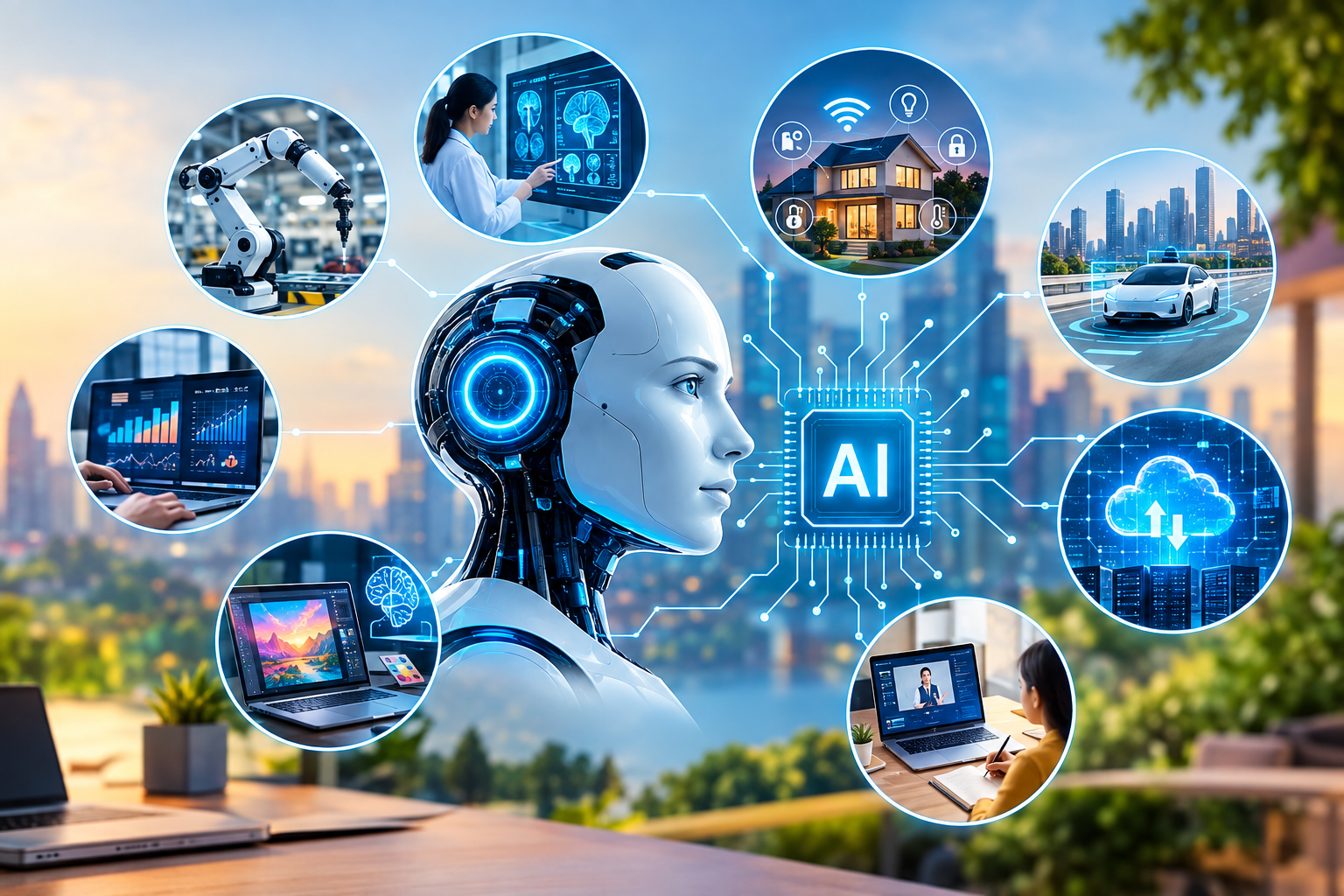
AI’s impact goes beyond business technology. AI is investigated and applied in the medical field, such as medical imaging, administrative tasks, medical research, and decision-support systems. For education, intelligent technologies offer assistance with personalizing learning and creating content.
AI is used in transportation to optimize routes, manage traffic and road safety, assist drivers, and plan logistics. AI systems can be used in agriculture to analyse crop conditions, weather data, and the requirements for resources.
The examples illustrate how AI can be integrated into broader technology ecosystems and not stand alone.
What are The Challenges that AI Poses?
While AI has many benefits, it also poses significant challenges. Data privacy, cybersecurity, accuracy, transparency, bias, IP, and responsible use are all factors organizations need to take into account.
AI systems can generate false or deceptive outputs, especially when the input data is of poor quality or incomplete. The automated decision-making process can also cause issues if it is not adequately tested and monitored.
This is why it is not enough to simply buy software and expect the adoption of AI to happen. Clear policies, proper data management, training, security measures, and continual evaluation are essential for businesses.
The Future of AI and Modern Technology
As AI technology advances, its integration with modern technology is sure to grow even closer. Generative AI, machine learning, intelligent automation, robotics and AI-powered analytics are already impacting product development and business operations.
The future holds the potential for more integration between AI and cloud computing, IoT devices, edge computing, robotics, and advanced data platforms. This could help to produce more connected and responsive digital worlds.
The most important shift may not be the outright replacement of all the technologies with AI, but the addition of an AI intelligence layer over many technologies. Those that grasp the potential for AI to add real value but ensure adequate human control will be more likely to thrive in this evolving landscape.
Conclusion
From enhancing automation and data analysis to creating more personalized experiences, improving software development, bolstering cybersecurity, and driving innovation, artificial intelligence is making significant strides in various aspects of modern technology. It is being used in a wide variety of industries and influencing product development and information management within businesses and their interactions with customers.
Responsible implementation is a key requirement at the same time. AI use needs to be backed up by adequate data, human knowledge, security, transparency, and governance. With the technology evolving further, AI is poised to be one of the dominating influence factors in the next generation of digital innovation.