Businesses are using artificial intelligence (AI) to improve their daily operations, communication with customers, information analysis, and decision-making. But, it’s not always necessary for companies to go through the process of replacing their current software to benefit from AI. Combining AI workflows with existing business tools can be a practical way to automate processes, boost productivity, and leverage existing technology in a more efficient manner.
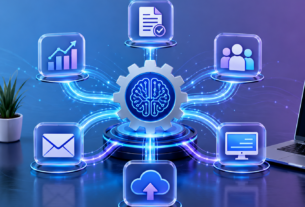
AI workflows are the means by which intelligent systems are integrated with applications like customer relationship management (CRM) platforms, project management applications, communication tools, accounting applications, marketing platforms, and data-management applications. This integration will enable AI to function within the existing processes and not as a standalone system.
Improved Business Productivity
The most significant advantage of AI workflows and current business tools is enhanced productivity. There is often a lot of time spent by employees entering data, sorting emails, updating records, preparing reports and moving data from one application to another.
Many of these tasks can be automated in an AI workflow. For instance, an AI workflow can gather the data from the web page and feed it into a CRM system, classify the inquiry, and alert the relevant staff member when a new customer contacts you via your website.
This frees up some time for employees to dedicate to more creative, strategic, communicative and problem-solving tasks. This can enable an organization to achieve more without adding needless staff.
Seamless Automation of Repetitive Tasks
In many cases, businesses utilize a number of tools to manage a number of functions. Email platforms can be utilized by marketing teams, CRM software by sales teams, and accounting apps by finance departments. If there is no automation, employees could have to enter information into these systems by hand.
AI workflows are able to integrate these tools and automate repetitive tasks. For instance, an AI-powered workflow could identify a qualified sales lead, update the CRM record, generate a personalized follow-up message, and assign the lead to a sales representative.
This makes the process more streamlined and eliminates unnecessary repetitive administrative tasks for employees.
Better Data Management
Companies collect vast quantities of information regarding customers’ interactions, transactions, web page usage, internal communications, and operations from systems. Having to keep track of this information in manual way is cumbersome and time-consuming.
Existing business tools can be used to gather, organize, classify, and process information with the help of AI workflows. Can automatically locate relevant data and transfer it to the relevant systems.
Improved data management also can minimize data duplication and data inconsistencies. If business systems are set up correctly, workers can have more structured and current information at their fingertips to help them make decisions.
Faster Decision-Making
The AI workflows can assist businesses in streamlining their information flow. AI can analyze vast datasets, look for patterns, summarize content and offer valuable insights, relieving employees from the tedious task of manually sifting through a ton of data.
An AI workflow that is integrated with the sales software, for instance, can review customer activity and determine leads that might need to be addressed immediately. Likewise, a marketing workflow can review how the campaign was performing and which changes are noteworthy.
Providing managers and employees with easy access to relevant information enables them to make better decisions and spend less time collecting and arranging information.
Enhanced Customer Experience
The expectations of customers are continually rising. Many people think that businesses can respond within a few seconds and give them information that would be relevant to them at several communication means.
AI can integrate customer service platforms, CRM systems, knowledge bases, email tools, and communication applications. This can aid businesses in automating various tasks like categorizing customer requests, generating initial responses, routing inquiries, and updating customer records.
For instance, if a customer reaches out to a customer support team, an AI workflow can be used to identify any inquiries and decide on which department should respond. This can decrease response times and support consumers reaching the right team on time.
Additionally, AI can help with personalization by leveraging data from existing business systems to deliver more personalized customer interactions.
Reduced Operational Costs
Automation can streamline organizations’ repetitive tasks and save time and resources. Workers are able to accomplish more in fewer hours since they spend less time in administrative tasks during the day.
It is also more cost effective to use the AI in conjunction with the current software systems than to replace them. AI can be integrated with these known platforms to enhance intelligent automation for businesses.
As time passes, increased efficiency and less manual work can lead to lower operating costs and utilization of resources.
More precise and less human error
Mistakes can occur when data has to be entered manually and repetitive tasks are performed. Even for experienced employees, it is possible to enter incorrect information or miss an item or to move data to a system that is different.
AI workflows can automate repetitive actions and standard workflows. For instance, a web form could automatically populate a customer’s data in a CRM system based on certain rules and conditions.
While AI systems need to be monitored and controlled, automation can minimize errors that may occur with repetitive manual tasks while increasing the overall consistency of the process.
Improved coordination between teams
If the business applications are used separately, the sharing of business information across departments might be challenging. Different platforms and processes may be used by sales, marketing and customer service, finance and operations teams.
AI workflows can assist in linking these systems. Specific events will trigger the automatic transfer of information between departments.
For instance, a sales opportunity may hit an important milestone, and an AI-driven process could send a notification to the finance team, update project-management data, and initiate a communication with the customer.
This makes the information more visible and assists teams to work from the same information.
Easy Scalability
As businesses grow, manual processes can become increasingly difficult to manage. Additional administrative workloads can arise when more customers, transactions, employees, and data are added.
Scalable automation for expanding operations, with AI workflows. After a workflow has been designed and appropriately tested, it is possible to handle more tasks without having to perform the same amount of manual work.
AI workflow integration is especially beneficial for companies looking to grow and remain efficient.
More Value From Existing Technology
There’s already a lot of software and digital platforms that businesses already invest in. But, there is a lack of full utilization of such tools since employees do some work manually.
AI workflows can reveal new potential with current technology. Rather than replace existing systems, companies can integrate them with AI functionality to build smarter systems.
This can also help to minimise disruption as staff are able to work with tools they are already familiar with.
Improved Workflow Monitoring
AI-powered workflows can help businesses monitor processes and identify potential bottlenecks. Automated systems can keep track of tasks, find out strange activity and offer data on the performance of workflow.
For instance, a business may measure customer response rates to emails or inquiries, or the number of leads that progress through each step of a sales funnel.
This data can be used to pinpoint unnecessary tasks and make ongoing enhancements to workflows.
Stronger Competitive Advantage
Integrating AI with current tech can enable businesses to be more responsive and efficient. By adopting automation, organizations can provide services faster, manage resources effectively, and meet evolving customer expectations.
AI is not the key to the competitive advantage. It is derived from the effective application of Artificial Intelligence in relation to the enhancement of real business processes.
AI workflows can help organizations build more efficient processes without having to overhaul their technology stacks if they are identifying repetitive and time-consuming tasks.
Conclusion
By leveraging AI workflows, businesses can seamlessly incorporate intelligent automation into their daily operations, creating a practical solution for implementing AI in business. By integrating AI workflows with existing business tools, businesses can seamlessly incorporate intelligent automation into their daily operations, creating a practical solution for implementing AI in business. AI can offer advantages in a variety of departments, such as increasing efficiency and productivity, managing data, improving customer experiences, and cutting down on operational expenses.
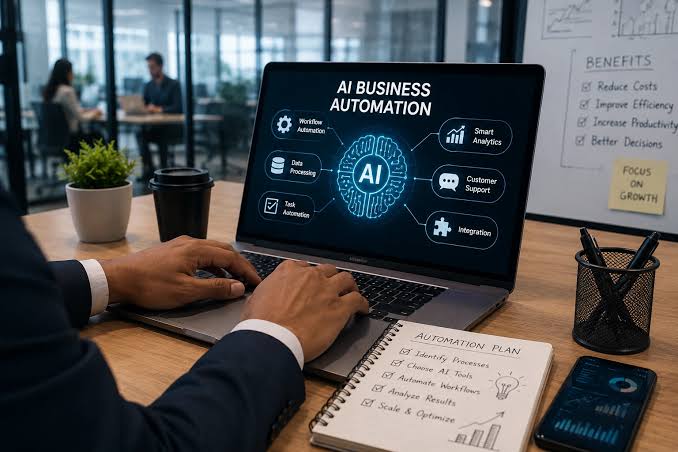
The best way is to determine which processes could benefit from AI automation and align it to the current tools that employees use, set controls to manage performance, and track it regularly. With the right approach, AI workflows can transform current business applications into a more integrated, effective, and capable technology landscape.